Put a Sticker Over the Title
Jul 14, 2026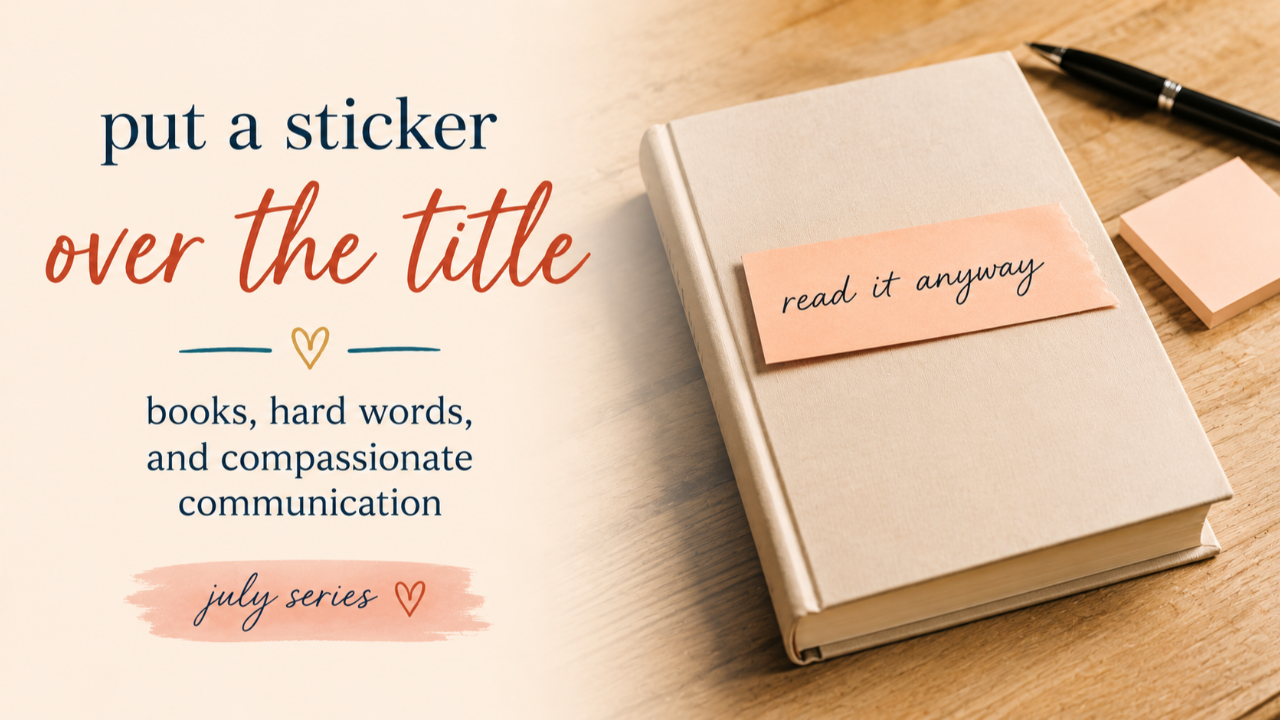
📌follow the Journal Prompt Board
Last week Llama Llama helped us begin our series on compassionate communication.
A small llama reached the end of his shopping capacity and tossed his feelings right out of the grocery cart. Me. Every time I go to the grocery store. Poor Mama, too…right?
That’s why I like using children’s books with these themes. This gives us a little distance. We can look at a llama in a grocery cart and notice what is happening without immediately using it as a way to judge ourselves. And if a children’s book has been written about it, that must mean it doesn’t just happen to us.
This week, we’re bringing in a book called Nonviolent Communication (affiliate link) by Marshall B. Rosenberg. The title might make you pause. It made me pause, but I hope you’ll stick with me.
I was not in a space for a book with that title when a friend recommended it to me. We talk about books often. I trust her recommendations. They go directly onto my book list.
Even though I put this one on my list, it felt heavy and serious. I judged the book by its title and didn’t put it at the top of my list. Later, my friend bought a copy and gave it to me. That’s when I saw the subtitle: A Language of Life: Life-Changing Tools for Healthy Relationships.
I’m grateful she did this because this book is profound and practical. It helped me think about communication that can be connected with compassion, responsibility, and everyday life. I think everyone should read this book.
And yes, we need to talk about the word violent. I don’t want the title to keep you from the wisdom of the book. Part of me wishes the title were different. I don’t think of communication as violent. You probably don’t either.
We say we snapped, we vented or we got irritated. We were just being honest, or we had a point to make.
Some of that may be true, but it’s also possible in those moments that our words made someone feel unsafe. Our tone might have taken away choice. Our sarcasm can be hurtful, and our silence might have been a wall.
We want to lean into compassion here.
Compassion invites us to tell the truth about what our communication is doing in the room and to the people we are talking to.
That’s why I’m glad the book has the title it has, even if it took me a while to get there.
The word violent makes us slow down and notice the harm our communication causes that we might otherwise not see. It’s still harm.
Words can hurt, tone can hurt, and so can not being heard. This causes pain.
Listen, we have all had our llama drama moments, and I don’t want us to get stuck there.
Nonviolent communication helps us practice for those moments. It gives us a way to notice what has happened, name what we feel, connect that feeling to what we need, and make a clean request.
Next week, we’ll look at one of the most helpful pieces of the book, the practice of separating what happened from what we feel, what we need, and what we are asking for.
I will be cheering you on,
Curious about life coaching? Message me. paigekullmancoaching@gmail.com
Sign up for the newsletter and the blog posts will come straight to your inbox.