Hello June! Let’s Have a Conversation About Conversation
Jun 02, 2026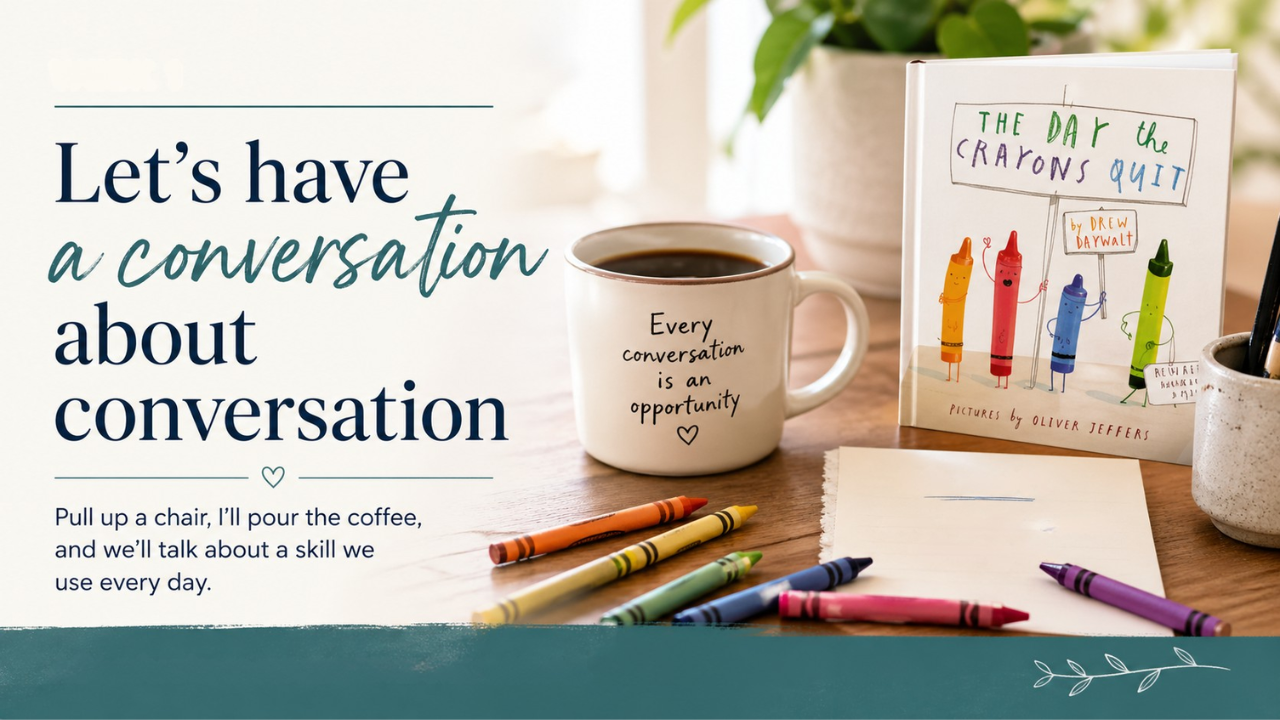
This post contains affiliate links. As an Amazon Associate, I earn from qualifying purchases at no cost to you. Thank you for supporting the work.
🔉Audio version available on Substack
📌Pins for journal prompts are here
That may sound like I’m being clever or sarcastic, but it also feels like the best way to start this month. We’re going to spend the next five weeks looking at conversation as a skill, so pull up a chair, and pour the coffee or tea. Let’s talk.
I actually pulled this theme out as something I wanted to bring to you back in January. I was thinking about conversations around the dinner table, probably because of all the time with the girls home for the holiday. I’d found a group chat on my phone an end of day that had gone south. Conversations…we have them all day long with our kids, our coworkers, our friends, on the phone, in person, or by email.
You know what? I think we spend a lot of time having conversations, but not much time exploring how we show up for them. I want to pull on that thread…with a children’s book.
The Day the Crayons Quit by Drew Daywalt opens with Duncan finding a stack of letters from his crayons. Each crayon has written to him about what it’s feeling and what it needs.
Red is exhausted from coloring every Santa, fire engine, and Valentine’s Day heart. Purple is losing his mind because Duncan keeps coloring outside the lines. Beige is tired of playing second fiddle to Brown. Pink has been sitting unused in the box because Duncan has decided pink is for girls, and she would like a word about that.
Some of the crayons are a little snarky. Some are writing in all caps. They are not perfect communicators, and that’s part of what makes this book so applicable. The crayons are saying the thing imperfectly. We often do the same thing.
Duncan, for his part, listens.
He read all the letters and was willing to hear their concerns. He could discern what they were really asking for and empathize with where each one was coming from. At the end of the book, he makes a new picture that uses every color the way each wanted to be used.
Two skills are being modeled here. First, the crayons are modeling the courage to say the thing, even imperfectly. Second, Duncan is modeling the willingness to hear the thing, which is what made it possible for him to understand what the crayons were actually asking for, and to do something about it.
These are important skills, but I’m encouraged, perhaps inspired.
If the crayons can say the thing, we can too.
Duncan has apparently been trained by Jefferson Fisher, and author who has a great deal to say about conversation. We’ll “talk” more about that next week.
If it has been a while since you read The Day the Crayons Quit by Drew Daywalt, it’s worth grabbing a copy or pulling it off your kid’s shelf. The whole month is going to lean on it. It’s about a ten minute read. You will smile.
I’ll be cheering you on,