The Small Shifts That Instantly Make Conversations Better
Jun 16, 2026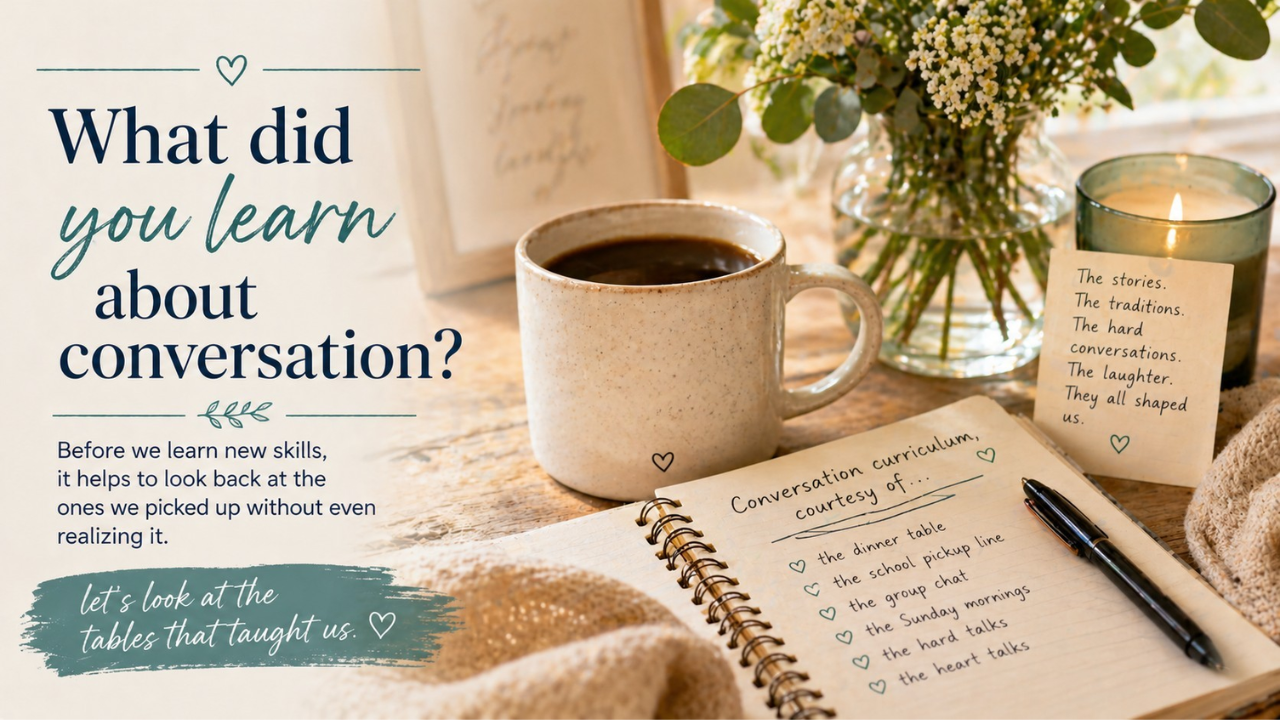
📌Here’s the Pinterest board for blog posts
📌Here’s the Journal prompt board
🔉Listen to the audio on Substack
Where did you gather the most information about how to have a conversation?
For me, I think it was around tables. I think the tables we grow up around are some of our earliest encounters with how to have a conversation.
What was yours like?
We had a round dining room table and if that’s where we were eating, it was animated, opinionated and often involved the onion skin Encyclopedia Britannica being hauled out to settle a question. On a good night the monstrosity of the Oxford English dictionary and a Latin dictionary were added to the mix. Topics were welcome, sources were expected, and a back-and-forth style was our natural rhythm. It was a table where I learned to be articulate and to be comfortable around smart articulate people. This was one conversational style I learned.
My grandmother had a big rectangular farm table in the middle of her kitchen. There was always coffee and your own personal mug. Snacks…salty, sweet, your choice appeared. My grandmother would sit with her coffee and you talked about what was going. Who had you seen? What was the news? It was casual, comfortable. There was a lot of laughter, and you didn’t hurry.
What about your tables? Was dinner at your house loud with everyone talking at once? Loudest person carries the conversation culture? Or was it quieter? Did you have to lean in to hear what someone was saying? Did the head of the table keep the conversation going? Did you take turns? Were kids supposed to listen or encouraged to chime in? Did you have a grandmother’s table too? Or a table at an aunt’s house? Or maybe a neighbor?
It seems to me, after reading The Next Conversation: Argue Less, Talk More (affiliate link), that most of my conversational skills were modeled at the various tables I sat around and I don’t think at the time, that I realized this was my conversation classroom. I’m pretty sure I didn’t realize that I was learning the skills that would become how I would converse with others.
I don’t exactly want a do over, but the book made me realize I could use some cleaning up, some refinement, maybe claiming a few guidelines. I’m not sure that learning conversation at those tables and then carrying it into every conversation we have leads to the kind of communication we actually want. (Thus, Jefferson’s subtitle argue less, talk more.) Conversations come in many forms and I don’t think good ones happen accidentally.
Maybe this is why Fisher’s book resonated with me so much. The skill we could bring in the world from applying his principles is profound enough that it should be a class.
This week, think about where you learned the art of conversation. Whose tables? What were the rules? No right or wrong answers, we’re just gathering information about your experience…a bit like Duncan reading each crayon’s letter before he made the new picture.
I hope you notice the conversations around your tables this week…and maybe even see them a little differently,

PS. There’s a pin at the top of the page for the journal prompt board. A new pin shows up each morning so you can dive deeper into the topic.
I think life coaching is the best kind of conversation. Message me and let’s talk about how to get started.