What If Better Conversations Could Change Your Life?
Jun 09, 2026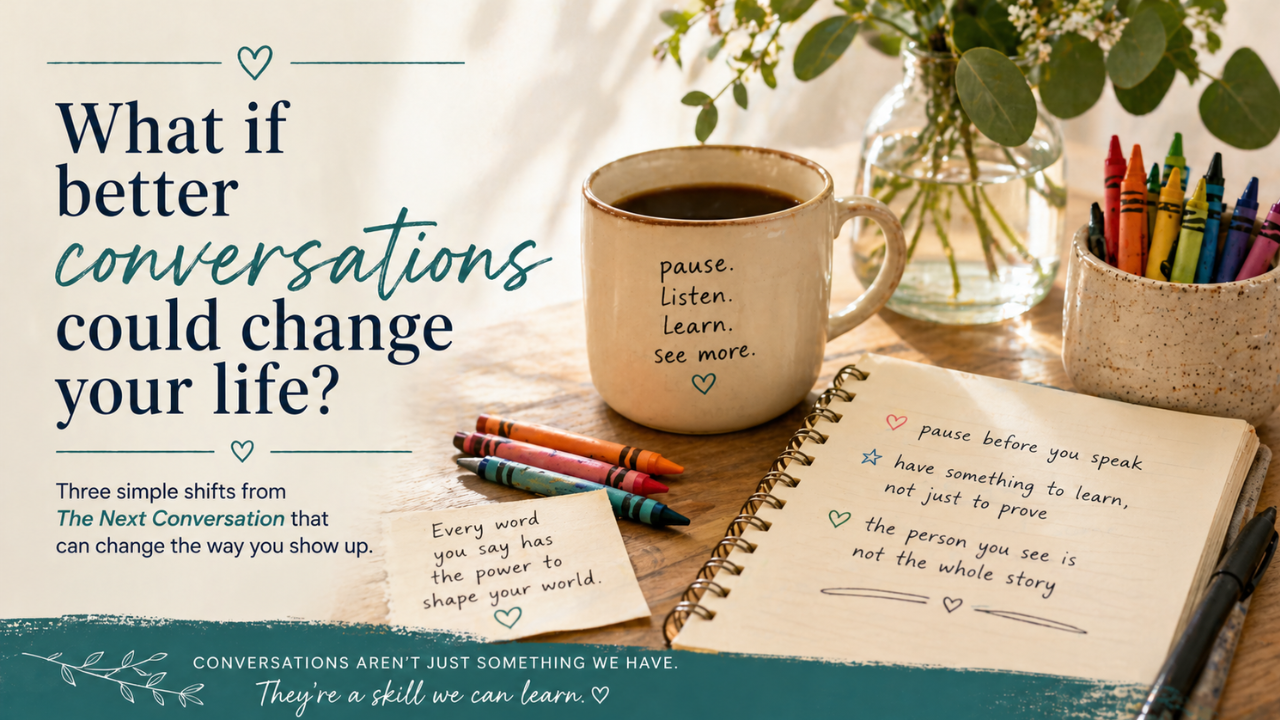
This post contains affiliate links. As an Amazon Associate, I earn from qualifying purchases at no cost to you. Thank you for supporting the work.
🔉Audio version available on Substack
📌Pinterest Grace Notes Blog Board
📌Pinterest Journal Board…A new journal prompt each day
Jefferson Fisher is a trial lawyer, a podcaster, and a writer. I feel like his website headlines say it best…
“A Better World
Begins with a
Better Conversation
Every word you say has the power to shape your world.
I’m on a mission to transform how you communicate—helping you build deeper connections, gain conversations, and take control of your voice.
Because when we talk better, we live better, one conversation at a time.”
And, somehow, I stumbled onto his book The Next Conversation. I was fascinated by the amount of pertinent detail he gives for good conversation. He believes it can be taught and practiced and that the results can change our lives. I’m a believer. (not the song.)
There is so much in his book, but since we started with simple crayons, I’m trying to maintain that simplicity. Here are a few things that stood out.
- Fisher says that the pause is the move underneath everything else. Before you speak, pause. Pause long enough to let the other person’s words land. Enough time to notice what you actually want to say rather than what you are about to say by reflex. It sounds almost too simple to be the foundation of a whole book…until you try it. Most of us are not having conversations. We’re trading reactions quickly. The pause allows the conversation.
Think about Duncan. He paused long enough to read all the letters before he did anything. That pause is the reason there could be a happy ending. He could have read the letter from Red and started arguing. He didn’t. He paused. - The second idea is a posture shift. Have something to learn, not just something to prove.
Wait. Don't rush past that. Let me give that to you again: Have something learn, not just something to prove.
Most conversations we struggle with are conversations we walked into wanting to be right or heard. We want the other person to understand. The problem is that if your goal is to be right or prove something, you’ve already closed the door on a conversation. There’s no room for anything but your way. Walking in with something to learn creates space for something to change. You can still be right. You may still be hurt, but you’ll also be able to understand the other person’s view. - The third one is this: The person you see is not the person you are talking to.
Everyone you speak with is carrying something you cannot see. The person who snapped at you at the checkout counter might have just had a fight with their best friend. The friend who sent the terse text might be navigating a hard day that has nothing to do with you. You’re not just talking to the person in front of you, you’re talking to the person in front of you plus everything that’s going on with them. That means if we are going to have a good conversation, we need to be aware of the person talking to us. That is the listening Duncan was doing with his crayons in The Day the Crayons Quit. He heard Red’s all-caps complaint about Santa and Valentine’s Day, and he did not take it as Red being snarky at him. He heard a tired crayon asking for a break.
Three gems:
- The pause.
- Have something to learn, not just to prove.
- The person you see is not the person you are talking to.
The book has so much more to say and I’m going to share more about next week. In the meantime, the book is The Next Conversation: Argue Less, Talk More by Jefferson Fisher, if you want to go deeper. I recommend the audio version of the book because…well the whole conversation thing but listening to him model it is gold, so is his weekly email.
I’ll be cheering you on, one conversation at a time,