How to Listen So People Feel Heard (And Why It Matters)
Jun 30, 2026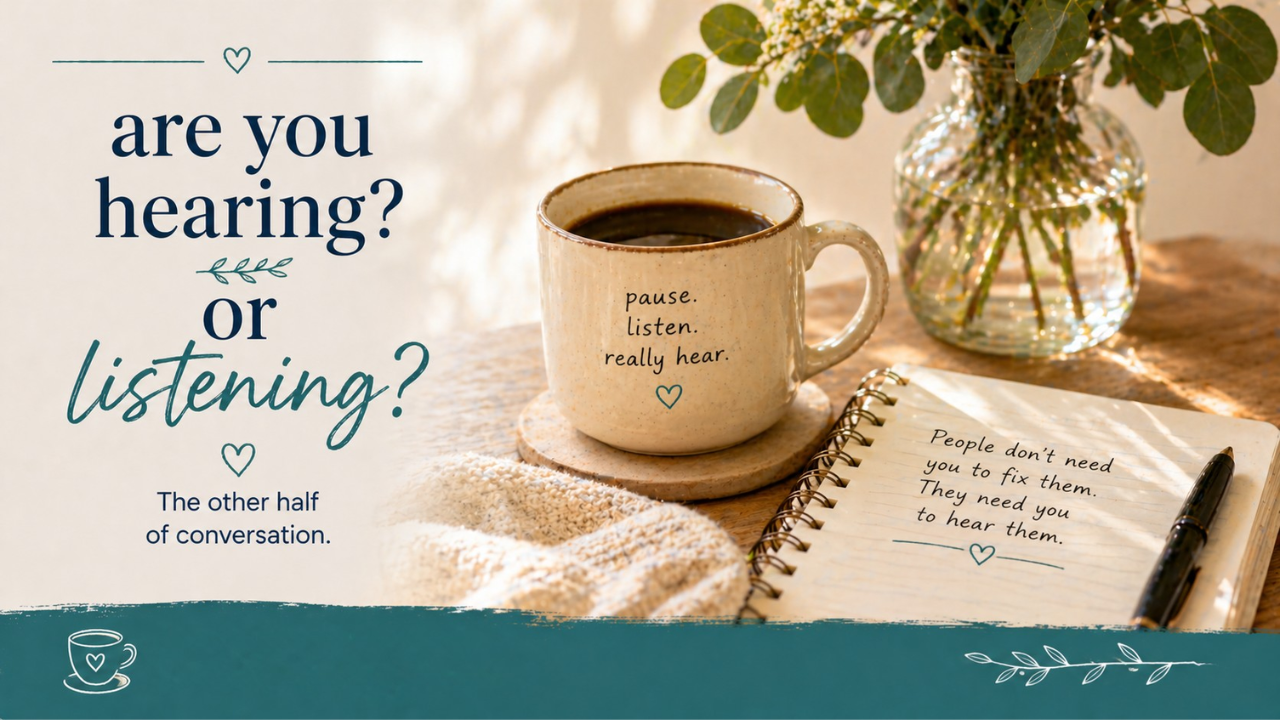
Do you remember the telephone game? Kids sit in a circle on the floor of their classroom. Someone whispers a sentence into the ear of the kid next to you, and you’re supposed to whisper it to the kid sitting beside you, but you can’t ask for it to be repeated. It travels around the circle, and by the end it has become something completely ridiculous. Maybe it started as “a big purple elephant,” and ended up “a black snake.” Everybody laughed. Somebody got blamed.
This is what I think the game was actually showing us.
Nobody in the circle was listening all that carefully. They were wiggling, or whispering to their best friend or making up funny stuff to say. It was always hard to hear all the words. Even though it was a listening game, we didn’t always listen well.
That is most adult conversations, too.
We have spent this month looking at conversation as a skill, and we have been focused mostly on the speaking side. The crayons modeling the courage to say the thing. Jefferson Fisher teaching us how to say it better. The different conversation styles we might have experienced. Last week, the pause, which is the first move in almost everything Fisher teaches.
But conversation is about speaking and listening. And most of us are not equally strong at both.
Go back to Duncan for a second. The crayons wrote their letters, and Duncan received them, and the thing he did that made the whole book possible was that he actually read the letters and listened to what the crayons said.
Often we hear when listening is needed. Hearing is when sound comes in, we catch most of it, and we move on. Listening is active. It requires a pause, which is why the pause from last week matters. It also asks for a willingness to let what the other person is saying actually register. To be sure we understand, that we heard all the words, and that we watch for cues for the meaning behind the words.
This is why Fisher’s idea that “ the person you see is not the person you are talking to” is such a good compass for listening. Everyone you speak with is carrying something you cannot see, and listening is a skill where we move below the top layer of their words.
Here is a question to sit with this week. Are you stronger at speaking or at listening? Most of us know the answer immediately. There is no right one. Some of us were trained to speak and never taught to listen. Some of us were trained to listen and never given permission to speak. Either way, the half we did not get is the half worth tending to now.
The crayon is still on your desk, or wherever you tucked it. The pause is still the practice. This week, just notice what happens if you try to receive what someone is saying the way Duncan received his letters.
That is the other half of the skill.
I will be cheering you on, and I will be working on the listening too.